
Introduction
Learning to play the drums is one of the most physically engaging and rhythmically fulfilling experiences in music. Drummers are the backbone of virtually every band and musical ensemble, providing the rhythmic foundation that makes everything else work. If you’ve ever found yourself unconsciously tapping rhythms on any surface available, drumming might be the perfect musical pursuit for you.
The drums have a reputation as a difficult instrument to start, largely due to the coordination required to make all four limbs work independently. While this coordination does take time to develop, beginners often find that progress comes faster than expected, especially once the foundational techniques are in place. This guide will walk you through everything you need to know to start your drumming journey on the right foot.
We’ll cover choosing your first drum setup (including quiet practice alternatives), basic technique, essential rudiments, your first beats and fills, and how to build a practice routine that delivers consistent progress.
Choosing Your First Drum Setup
For beginners, there are two main options: acoustic drums or an electronic drum kit. Acoustic drums produce the authentic sound and feel that every drummer aspires to, but they require significant space and can be extremely loud — a serious concern for home practice. Electronic drum kits offer quiet practice with headphones, a smaller footprint, and a wide range of sounds, making them the practical choice for most home beginners.
A starter acoustic drum kit (bass drum, snare, hi-hat, two rack toms, floor tom, and a crash cymbal) typically runs $400-600 for entry-level sets from brands like Pearl, Ludwig, and Mapex. An electronic kit like the Roland TD-1K or Alesis Nitro starts around $300-400 and includes everything needed for quiet home practice. For apartment dwellers or those with noise restrictions, an electronic kit or mesh-head pad setup is virtually the only viable option.
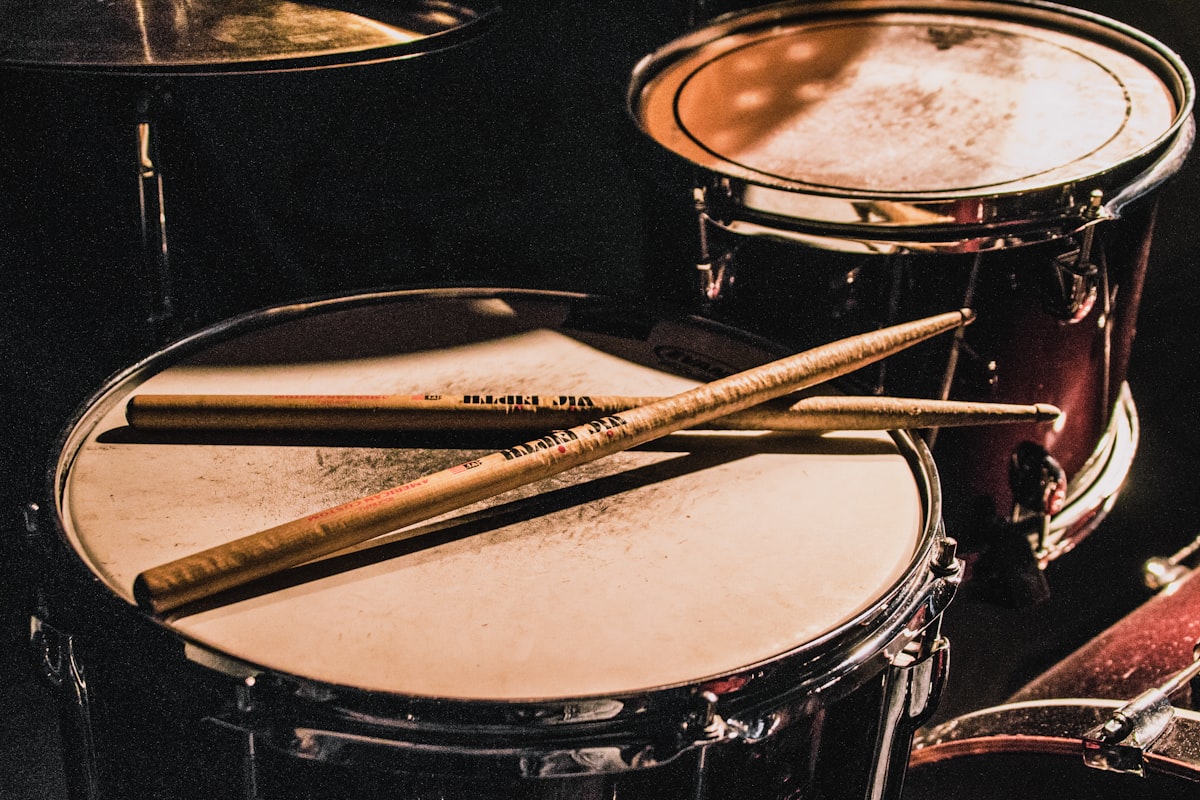
Don’t neglect accessories: a drum throne (seat), kick drum pedal, drumsticks, and a practice pad are all essential. A practice pad — a rubber pad that approximates the feel of a drumhead — is invaluable for developing rudiment technique in any location without making noise. Many professional drummers still practice on pads regularly throughout their careers.
Basic Technique and First Beats
Proper stick grip is the foundation of good drumming technique. The two most common grips are matched grip (both hands holding the stick the same way, which is standard for popular music) and traditional grip (different hand positions, associated with jazz and marching). For beginners playing rock, pop, or hip-hop, matched grip is the standard starting point.
Hold the stick between your thumb and index finger, with the other fingers curled loosely around the stick. The fulcrum point (where the stick pivots) should be between the thumb and the middle of the index finger. Allow the stick to bounce naturally after each stroke — this “rebound” is essential to speed and efficiency. Practice basic strokes (full, down, tap, and up strokes) on a practice pad before moving to the kit.
Your first beat: the standard rock beat uses the bass drum on beats 1 and 3, the snare on beats 2 and 4, and the hi-hat on every eighth note. This combination — bass, hi-hat, hi-hat, snare, hi-hat, hi-hat, bass, hi-hat, hi-hat, snare, hi-hat, hi-hat — is the foundation of thousands of songs across virtually every popular genre. Master this beat slowly with a metronome before attempting fills or variations.
Rudiments and Practice Structure
Drumming rudiments are the fundamental vocabulary of drumming technique — standardized patterns that build control, speed, and coordination. The 40 Essential Rudiments established by the Percussive Arts Society include patterns like the single stroke roll, double stroke roll, paradiddle, and flam that form the technical foundation of all drumming styles. Practicing these regularly is the equivalent of scales for a pianist or guitarist.
Structure your practice sessions to include: warm-up on a practice pad (5-10 min), rudiment practice (10 min), working on a specific groove or fill at slow tempo with metronome (10-15 min), and fun time playing along to music you enjoy (5-10 min). This balance of technique, structured learning, and joyful playing accelerates development while keeping practice enjoyable.
Frequently Asked Questions About Learning Drums
Do I need an acoustic drum kit to learn properly?
No. A quality electronic kit with mesh heads provides excellent practice feedback and develops the same foundational skills as acoustic drums. Many professional drummers learned and continue to practice on electronic kits.
How long does it take to learn basic drum beats?
With 20-30 minutes of daily practice, most beginners can play a solid basic rock beat within 1-2 weeks. Playing along to simple songs comfortably typically takes 4-8 weeks of consistent practice.
Do I need drum lessons, or can I learn from YouTube?
YouTube channels like Drumeo, Stephen Taylor Drums, and Mike Johnston offer excellent free instruction for beginners. However, even a few lessons with a teacher to establish correct technique and avoid bad habits can be very valuable, particularly for grip, posture, and kick drum technique.
How do I practice quietly?
Use a mesh-head electronic kit with headphones, practice on rubber pads or a practice pad for rudiment work, or use low-volume drumheads on an acoustic kit. Many beginners build significant skill entirely on practice pads before ever getting a full kit.
Is drumming physically demanding?
Drumming is one of the most physically demanding instruments to play at a high level. However, beginner drumming is accessible to most people with normal fitness levels. Regular playing gradually builds the specific endurance and coordination required. Warm up before long sessions to avoid strain.
Final Thoughts
Learning drums rewards patience and consistency with profound musical satisfaction. There is nothing quite like playing in a band, or even just playing along to your favorite songs, with the rhythmic power that drumming provides. Start with a basic setup, focus on correct technique from day one, and commit to consistent daily practice.
The coordination challenges that feel daunting in the first weeks become second nature with time. Every professional drummer started exactly where you are now — struggling to get their hands and feet working together. That struggle is temporary; the skills you build are permanent.
Sources & Further Reading
- Drumeo: Free Drum Lessons for Beginners
- Percussive Arts Society: 40 Essential Rudiments
- Modern Drummer: Drum Lessons and Techniques

Sarah Chen
professional guitarist
Sarah Chen is a professional guitarist and music educator with a Bachelor’s degree in Music Performance from the University of Southern California. Based in New York City, Sarah has over a decade of experience teaching guitar, music theory, and ear training to students of all ages and skill levels. She is passionate about making music accessible to everyone and regularly contributes guides on learning instruments and music fundamentals.